(This is the fourth essay I have posted that did not make my memoir: Leaving The Land of Numb–A Journey to connect My Emotional and Spiritual Lives. This essay has a powerful story my Grandma Follis told me about what happened right after my Dad returned home from the Korean War. My Memoir releases from Amazon on July 10. Just around the corner… Yay!)
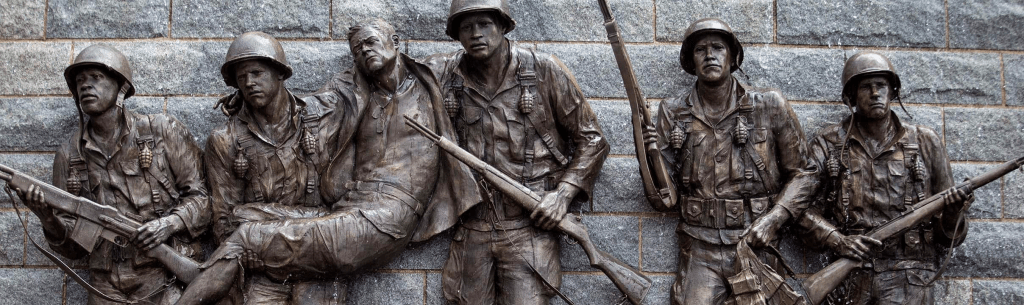
On a fall morning when I was in high school and my brother Bob was in junior high, Dad asked us to help him clean out the storeroom in our basement. When we started moving around boxes, Bob came upon one with these words written on the box in black marker: “D.A.’s army uniform.” Dad’s name was Darrel Allen, but people called him D.A. and D.A. is on his headstone.
Bob pulled back white tissue paper, and there lay my Dad’s neatly folded dress uniform. Dad was as a platoon sergeant during the Korean War. Like so many men of his generation who went off to war, when he returned, he rarely talked about it, and even then, saying very few words. From Korea he wrote lots of letters to my Grandma Follis and to my Mom, to whom he got engaged just before leaving for Korea. Sadly, somewhere along the way all those letters somehow got thrown out.
Picking up the uniform, Bob said, “Wow Dad, look at this.” Holding the green wool dress jacket up to his chest, Bob said, “You were a hero.” That comment set Dad off. “Do not call me a hero. The heroes never came back. Put the uniform back in the box.”
Bob did as Dad said and there were no other words spoken. We just went back to cleaning. Dad sealed the box with tape, and shoved it to the corner.
—–
In the summer of 1952, after being away 14 months, Dad returned to California on a ship, got his discharge papers and hopped a train to Jennings, Kansas, where my Grandma and Grandpa Follis lived, and where, most important, my Mom, just 18, was waiting to meet him. (Yes, she was barely 17 when he left for Korea.)
Before leaving, he and mom decided to marry as soon as he returned—“If he made it back,” as my Grandma Follis put it. They were married on October 20, 1952. In mid-September a couple of weeks after Dad returned to Kansas, Grandma Follis threw a big party for people to congratulate Dad for serving his country and to wish the love birds well in their upcoming marriage, just a month away. The morning of the party Dad helped set up. He started watering the flowers.
Grandma Follis described the scene. “It was noon, and your Dad was out watering my flowers. I remember it was noon because the noon whistle blew.” As the siren blared, signaling High Noon, Grandma Follis stepped out onto the front porch to chat with Dad. But she didn’t see him. That was odd because she had seen him just seconds before. Puzzled, Grandma said she looked all over, even walking around the entire house. The water hose was running, laying on the ground. She was baffled until Dad finally crawled out from behind the flowers, covered in mud. When the whistle blew, he dove for cover.
After he stood up, Grandma said Dad gave a little laugh, shrugged and went inside to clean up. When he emerged in clean clothes, Grandma asked him what happened. “Nothing,” Dad said.
“Did the siren going off at noon remind you of the war?”
“I don’t know.”
Grandma cried when she told me the story.
“What did you say to him?” I asked.
“Nothing,” she said. “I thought it best to just keep quiet.” She said Dad picked up the hose and went back to watering the flowers. “He never mentioned it again, and neither did I.”
—–
A few days later, something compelled Dad to tell Grandma Follis about one very painful instance. It was the only one he ever mentioned. He told her that one day he and his men got trapped on a hill in a firefight. “We lost some men,” Dad said.
“That’s all he said,” Grandma Follis said. “Nothing else.”
After Dad died in May 2009, I asked Mom about that. She said that Grandma Follis told her about it. And in fact, early in their marriage Mom said she prodded Dad many times to talk about his experiences in Korea. “I said, Darrel, would you like to talk? I’d be willing to listen.’”
“There’s really nothing to say,” Dad told her.
Mom continued. “Then one day after I asked him again, he looked straight at me and said, ‘Pat, if there is more you need to know about what happened to me over there, you will be the first to know.’ And that was it. He never brought it up again and neither did I. We’ve had a really great marriage. There are just some things I did not need to know, and that’s okay.”
—–
But then, 40 years later, she got caught off guard one afternoon and brought it up again. During the Gulf War in 1990-1991, the Kansas National Guard Unit in Colby was called up to serve, helping refuel army vehicles used in Operation Desert Storm. Before the guard unit left for the Middle East, several members spent an afternoon at the local headquarters writing their personal will. Two men in the guard worked for my Dad. Mom called me that evening. “Dad was pretty upset when he told me that his men had written their wills this afternoon.”
“What did he say to you?” I asked.
“Nothing really, but I could tell he was upset. He is out for a walk now.”
We hung up and didn’t talk about it again until the guard unit returned and the city of Colby gave a parade for the returned unit. Mom called that evening and said, “After a few trucks had passed by our home, I looked over at Dad and tears were running down his face.”
“Wow, Mom! What did you say?”
“Nothing. He sat there quietly watching the parade of trucks.” After the parade, they walked back into the house where she said she asked Dad, “Are you okay? When the guard members rolled by in their trucks, you seemed pretty emotional.”
“I am okay.”
Are you sure?”
“Yep.”
Mom said Dad then gave her a kiss followed by a little closed mouth smile. We all knew exactly what that meant: “I have nothing else to say.” With that, Dad got in his company car and drove back to work.
“Boy, there were some emotions there, Mom,” I said.
“Obviously.”
“Do you think you’ll bring it up to Dad again?”
“Don’t plan to. Dad knows exactly where I am if he ever wants to talk.”
 donfollis.com